
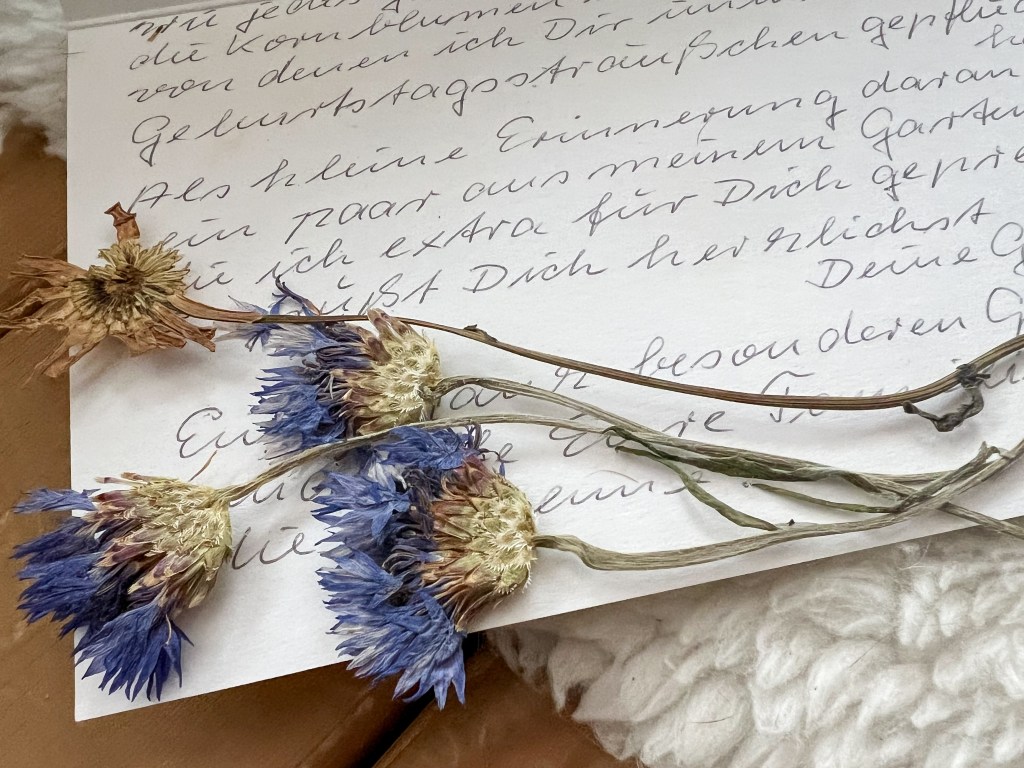
My very own, now eighty-five-year-old fairy godmother once told me that I was all the cornflowers of her life. A statement so poetic and pure, so whimsical and thoughtful, it’s undoubtedly one of the most beautiful things anyone has ever said to me. What a gift to plant into a little girl’s heart! A girl of summer, born on the last day of June during the cornflowers’ peak bloom. Each year on my birthday, my godmother would come to my family home to celebrate with us, a bag of presents in one hand and, in the other, a bouquet of freshly picked cornflowers she had collected, one by one, right next to our rural region’s ripe grain fields, where the cornflowers’ deep blue stood in astonishing contrast to a golden backdrop. She would do this each year, without fail, until I grew up and moved away from home. But it wasn’t until I received her birthday card, not too long ago actually, that I fully realized the monumental weight of my godmother’s kind, sentimental gesture throughout my childhood. Before I even read her words, written in familiar cursive, a few dried cornflowers safely tucked into the card’s fold stopped me in my tracks. They instantly ignited this mental film reel of memories and images of her, like a puzzle completing itself in my mind. She had grown cornflowers especially for me in her garden that year, she wrote, because in a world full of herbicides and manicured lawns, wild cornflowers had become increasingly hard to find. It took this gentle reminder, my adult experience, and a more farsighted worldview to fully see her and appreciate the decades of her unwavering, unconditional love and mentorship, all culminated in one precious flower.
Ironically, or even more so, I have a deep appreciation for wildflowers and the tiny critters that depend on them. I stop to take their photographs on walks or hikes, learn their names, and point them out to my children. Even at our temporary homes, I cultivated entire butterfly gardens to give the insect world and hummingbirds a break, and in turn receive an immeasurable amount of personal joy from their delight. One more unique than the other, I like to think of wildflowers as the pure, child-like, resilient, and free-spirited optimists of nature. They are reassuring reminders of a better tomorrow, representing the preciousness of wild, unpretentious beauty. The fact that someone in the world looks at a particular wildflower and thinks of me, smiling, is my very own, real-life fairytale.
If you read into the history of cornflowers, you quickly realize that they are as old as time itself. Ancient cultures not only celebrated the cornflower’s significance as an edible, medicinal herb or its believed protective powers against evil spirits but also associated it with purity, grace, and independence, hope and good luck, love and devotion. The cornflower is the symbol of the Roman goddess Juno, the goddess of marriage, the symbol of fertility, and the patron saint of women and children. The parallel here with my June birthday is beyond neat. Moreover, the floral collar of ancient Egypt’s Tutankhamun, discovered in his embalming cache, contains well-preserved rows of cornflowers. The most precious sapphires in the world are categorized as cornflower blue, and in France, the cornflower is worn in remembrance of World War I’s Armistice. Native to Europe, it’s also the national flower of Estonia and historically the symbol of Prussia, and Germany as a whole during the nineteenth century. Prussian blue was cornflower blue. Fleeing the Napoleon army, Queen Luise of Prussia kept herself and her children alive by hiding in a field of cornflowers. Even the Dutch painter Johannes Vermeer described his favorite color to be this particular shade of blue, a hue the Scottish famously refer to as bluebonnet.
Most likely, this is more than you ever wanted to know about cornflowers. Point is, the ripple effect a single wildflower can have on time, space, hearts, and minds is unbelievably magnificent. The cornflower has helped, connected, and fascinated literal armies of people, wave upon wave of generations, entire cultures and countries, the arts and politics, showing us what an impressive orbit undemanding beauty can create. And somewhere along that orbit is the tale of my godmother and me, two people forever connected by the simple, yet priceless gift of a bouquet of cornflowers on a warm summer day each year. Just as I’ve been all the cornflowers of her life, she will remain all the cornflowers in mine. A striking bond time-capsuled in history. It’s a bond as striking as cornflower blue.


 Little Life Chronicles